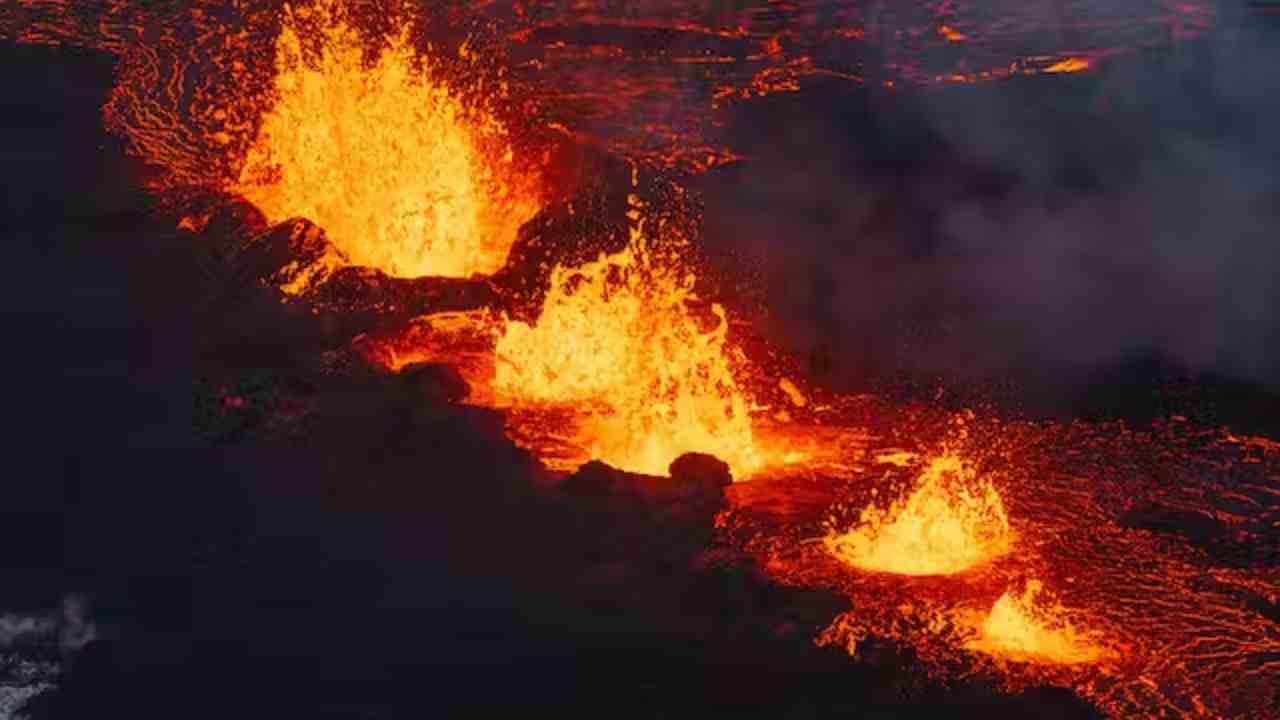
A volcano erupted late on Monday in southwest Iceland, spewing lava and smoke across a wide area after weeks of intense earthquake activity, the country’s Meteorological Office said. Fearing a significant eruption on the Reykjanes peninsula, authorities evacuated the nearly 4,000 inhabitants of the fishing town of Grindavik last month and closed the nearby Blue Lagoon geothermal spa. The eruption did not pose an immediate threat to human life. Still, the area is being monitored, and flights in and out of the nearby international airport in Reykjavik remain unaffected, according to the government statement. It added that the risk to power and other energy infrastructure was also being assessed.
The eruption started near a fissure known as Hagafell, north of Grindavik, and lava has been spewing at a rate of 100 to 200 cubic meters per second, several times more than in previous eruptions, the Met Office said. Images and live streams by local news outlets showed molten rock shooting from the ground in bright yellow and orange colors, which contrasts dramatically with the night sky.
Iceland’s volcanic activity is challenging to predict, but a sudden eruption close to a town is unusual, especially after eight centuries of dormancy in the Reykjanes peninsula. Its volcanoes lie along the boundary between the Eurasian and North American tectonic plates, which makes it a seismic and volcanic hot spot as they move in opposite directions.
Geologists have been keeping a close eye on the development, but the exact nature of the new eruption still needs to be clarified. It could be a “lava fountain” with no explosions or a “magma flow,” a volcanic specialist told public broadcaster RUV.
But he also stressed that a major eruption was not imminent and the direction of the lava was still unclear. “It could be heading towards the town, but it’s also possible that it will go somewhere else,” he said.
He urged residents to follow the advice of officials’ advice, stay away from the eruption site, and take precautions if they were in the vicinity of their homes. He warned that there was a high chance of ash forming from the eruption and that the lava’s direction could change quickly, especially during the night.
The Met Office said it was preparing to send a helicopter to the area to confirm the extent of the new eruption and assess its effects. Located just off the coast of the Atlantic Ocean, Iceland is home to 33 active volcano systems and is one of the most active volcanic countries in Europe.