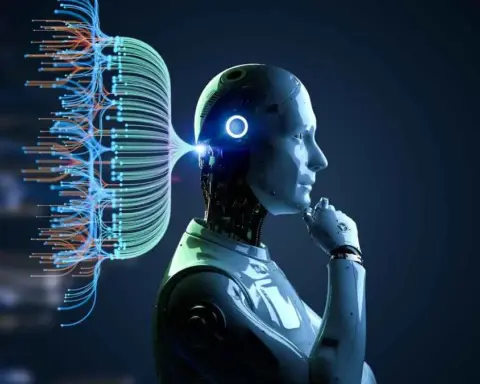
Artificial intelligence might turn out to be the greatest technological innovation that humankind will ever get. This statement is made without any kind of marketing motive, technological euphoria, or any other kind of overenthusiasm. It is simply the view of more and more scientists thinkers economists, and planners who look into the power of AI, its potential to bring positive change, and its influence on many aspects of human life. This is a new technology so in a way, it is similar to the discovery of fire, creation of printing press, invention of electricity, discovery of nuclear energy that the world was able to harness and use with a degree of safety and responsibility.
But in this case, artificial intelligence might bring a great deal of benefit and can also be a source of serious harm, and the balance between these two consequences cannot be taken for granted. The decisions that scientists, big companies, governments, and private individuals will make on the development, deployment, and governance of AI will shape the reality of it at present. Knowing that, being good at understanding modern trends will require having knowledge of the two parts of that situation. It is essential, really!
The Benefits: Redefine What’s Possible
The most obvious advantages of artificial intelligence are the applications that have already entered our world. Email spam filters, traffic-dodging navigation applications, personalized streaming recommendations, voice-controlled digital assistantsall are so common that we no longer think of them as AI. But they are merely the tip of the iceberg. AI in medicine is becoming capable of transforming the fundamental nature of the link between medical knowledge and the health of human beings. A small machine learning program, trained on tens of thousands of medical images, can identify cancers, diabetic retinopathy and heart problems at levels of speed and accuracy of levels way beyond the reach of any human doctor (although admittedly not just yet of the clinical expert they outrank).
AI-powered drug discovery programmes are reducing the century+ needed to identify promising drugs down to months (or even weeks). AlphaFold has cracked the decades problem of protein folding into 3 dimensions; an open door to new approaches to understanding how disease works. In education, AI is enabling the first truly adaptive personalized scale-able learning experiences dynamically diagnosing student understanding, adapting the presentation of content to the students needs in real time, and giving a level of personalized attention that current classrooms, with a teacher to thirty students, can never match.
In climate science, AI is improving the precision of climate models, balancing electric power grids to maximize use of renewables, and revealing correlations in social and environmental data that would take human scientists decades to sort through manually. In economic development, AI is expanding access to financial medical educational, and legal services for those who have never been served before, constrained by distance, cost, or under-resourced institutions.
AI will have a major effect on productivity in all sectors of the economy. Now, tasks that would have taken hours of skilled human labor can be performed in seconds. AI tools can augment functions that require specialist expertise, making that expertise available to a much wider audience. If managed well, this productivity expansion could be one of the biggest improvements in human living standards since the industrial revolution in terms of economic value.
The Risks: Where the Dangers Lie
All of these benefits come with real and serious risks that need to be taken just as seriously as the optimism about the possibilities of AI. They are not the same and they are not equally probable, but they are real. Dismissing them as science fiction or as being the concern of people who don’t understand the technology is not a position that is supported by the evidence.
The most immediate and widely felt danger is that of the displacement of human labor at a pace that may outstrip society’s capacity to adjust. AI is not merely automating the mundane and repetitive tasks that earlier waves of automation sought to automate. It is exhibiting an ability to do cognitively complex work such as legal analysis, medical diagnosis, financial modeling, software development and creative work. This wave of job losses threatens many of the jobs the middle class has traditionally counted on for stable, good-paying work. The fear isn’t that A.I. will wipe out all jobs—history suggests that new kinds of jobs do tend to arise from technological disruption—but that the transition will be painful, long, and deeply unequal across different communities and nations.
Recommended for you:
- Who Is Julie Sweet? Accenture CEO’s Career and Achievements
- Cleansing or Cure-All? Separating Fact from Fashion in Colon Therapy
- How to Succeed in a Finance Career: Essential Skills and Strategies
- The Future of Supply Chain Operations: Harnessing the Power of Artificial Intelligence
- Once Upon a Time in Harlem Review: More Than a Staggering Time Capsule
The centralization of AI power within a small handful of technology companies and the governments that host them raises profound questions about market competition, data sovereignty, and geopolitical balance. The organizations behind the most powerful artificial intelligence systems have capabilities that no previous private organization has had in persuasion, surveillance, prediction, and automation. The potential for that power to be exercised in ways that benefit shareholders or governments at the expense of broader populations is not speculative.
AI-generated disinformation is a threat to the epistemic bases of democratic society. The same technology that helps creative people make engaging content also helps bad actors create synthetic media — deepfake videos, fake audio recordings, convincingly written fake news stories — at a scale and quality that makes it increasingly difficult to distinguish fact from fiction. AI-enabled disinformation is an ever-growing and grave menace to public trust, democratic processes, and social cohesion in an information environment that is already suffering from the corrosive effects of social media on shared reality.
Algorithmic bias, the tendency of artificial intelligence systems trained on historical data to reproduce and amplify the inequalities that such data encode, is a risk in every area in which AI is used to make decisions affecting people’s lives. There are known instances of AI causing harm, not through malicious intent, but through uncritical reproduction of existing injustice: hiring algorithms that discriminate against women, credit scoring models that discriminate against minority communities, and criminal justice tools that reproduce historical racial biases in policing.
Guiding Toward the Better Result
Artificial intelligence’s benefits and risks are not equally inevitable. The benefits tend to be found when the development of AI is directed by genuine concern for human welfare, under tight supervision, and used where its capabilities are matched to its limitations. Those risks are more likely to materialize when we do not have those conditions — when speed of deployment outstrips understanding, when profit-motives trump safety considerations, and when those most impacted by artificial intelligence systems have the least input into how those systems are designed and governed.
The most important decisions about AI are not technical decisions. They are moral and political questions about the kind of future we want, who should benefit from its capabilities, and what constraints are necessary to ensure that the most powerful technology in human history benefits humanity as a whole, rather than the narrow interests of whoever happens to control it.
There is no guaranty that AI will be our salvation, nor that it will spell disaster. It is a mirror of the values, priorities, and wisdom of those who build and deploy it. Its future depends on the choices we make today — and knowing its benefits and risks is the beginning of making good choices.