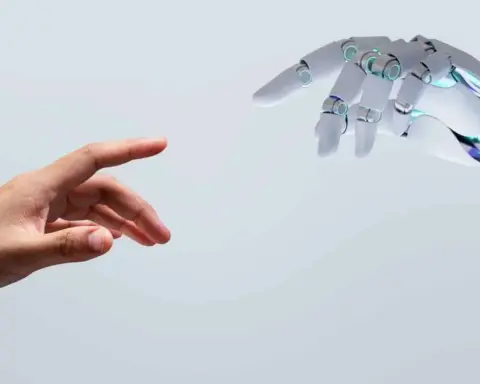
Introduction: Adapting to an AI-Driven World
Artificial intelligence (AI) is quickly changing the technological environment, making changes to industries, changing the nature of professional positions and modes of communication, learning, and doing business. Whether it is automated customer services, intelligent analytics, generative content production, or decision support systems – all of these innovations have stopped being a mere experimentation and entered our lives in a serious way. The question that people and companies need to ask in the face of such fast development is the following: how do we cope with artificial intelligence and keep our humanity intact?
This is neither about fighting technology nor embracing everything blindly. This is about finding the balance and knowing how to cope with artificial intelligence.
Understanding the Changing Role of Artificial Intelligence
One of the main problems regarding artificial intelligence is the pace at which it changes. Devices that once required special training are now available in user-friendly interface designs. The tools can produce written material, work with big data, translate different languages, help with coding, and even take care of the administrative side of work.
There are plenty of positive aspects to all these innovations: the opportunities for increased efficiency and new ways of innovation arise. Companies can optimize their processes, entrepreneurs can cut some costs associated with business, while people themselves can save time completing many different tasks.
On the other hand, every technological advancement brings about uncertainty: employees start worrying about their jobs, students about the necessity of their studying, and businesspeople – about which technology is worth investing in.
It is essential to understand the difference between the two types of activity and to know which of them will be automated by computers and which still requires human intervention.
1. Embrace Continuous Learning and Skill Development
In an AI-powered economic system, education is not supposed to be regarded as some qualification that was earned at one particular moment and used for the whole of someone’s life. Constant learning became a must to remain relevant in a specific field.
One should learn how to use appropriate AI programs in their profession: writers – in their research and editing; marketers – to make intelligent analytics; designers – to try out the possibilities of generative systems; and business people – to automatize their workflow.
However, being able to work with an AI system is not everything. Important skills such as critical thinking, problem-solving, communication, adaptability, and professionalism are still needed to obtain the desired result.
The best way to start using technology is to spend a little time on learning about one tool per week.
2. Use AI as a Productivity Partner, Not a Substitute for Thinking
The most effective approach to adapting to AI is regarding it as a personal assistant who improves people’s skills. An intelligent procedure will include identifying the goal, utilizing artificial intelligence to speed up tasks relevant to it, evaluating the results against credible sources and then making an independent decision.
In other words, for students, this will involve employing AI to better understand difficult material. In the case of professionals, it will mean employing automated analyses to guide their decision-making process.
3. Prepare for Employment and Business Transformation
The relationship between AI and employment is a complex one. While certain tasks and roles may be eliminated through automation, there will also be a lot of jobs created around the adoption of AI technology, data security, digital governance, cyber security and other tech-related work.
Naturally, this would impact various industries, occupations, and places of origin in various ways. What it means is that it is neither wise to assume that every job will get automated, nor it is wise to hold that nothing will.
Employees should identify the repetitive activities in the job, and envision how AI can assist them to better accomplish those activities. The entrepreneurs can consider using it in order to provide customer support, analyze the market, develop the content, manage the inventory, and automate the workflow.
However, the companies should concentrate more on the education and proper automation of processes rather than cost reduction. Adaptability, the ability to put into practice what you know, and be open to the challenge of a new way of working would be an asset in the future job market.
4. Protect Privacy, Accuracy, and Ethical Standards
With the rapid rise of AI, we have important issues around personal data, intellectual property disinformation bias in algorithms and cybersecurity.
Users should be aware of what data can be stored in the tools they are using and not enter confidential business data, financial information, sensitive personal data or confidential files into those tools.
In the same way, any information fed into AI systems should be assessed with the same rigor, mostly if it relates to medical, legal, financial, or other similar decisions.
5. Maintain a Healthy Balance Between Technology and Human Life
Technology should provide more room for freedom, efficiency and communication and not be the main tool for evaluating one’s success.
It is important to understand that people still depend on their personal connections, passions, emotional state and experience.
Conclusion: Moving Forward with Confidence
AI is pioneering technology with great potential and genuine difficulties too. To tackle the transition, one must have qualities like curiosity knowledge reasoning, moral awareness, and flexibility.
People that constantly improve themselves, enhance human abilities, and work with AI in the right way are destined to cope well with the new environment. Companies able to innovate in a proper way and adequately develop their workforce will be able to create robust systems as well.
And last of all, it’s not about trying to compete with the machine in a useless competition, but to know where it is better than you, where a human is needed and to use all of those.
The future will not only come from the technology itself but also from the choices that people will make for its development, implementation, and governance. Through such an approach, one can transform the disruption of technology into genuine progress.