
Canadian rapper Drake, who is well-known for his hit songs and opulent lifestyle, made an honest admission that shocked the entertainment industry and social media: he lost more than $8 million in sports betting in a single month. On June 18, 2025, the Grammy-winning musician, whose real name is Aubrey Graham, posted a screenshot of his betting account on Instagram Stories, revealing an astounding $124.5 million in wagers and a $8.2 million deficit. “Gotta share the other side of gambling,” the caption reads. Drake’s post, “Losses are so fried right now,” provided a unique window into the competitive realm of celebrity gambling and spurred a larger discussion about its more sinister connotations. The cultural phenomenon known as the “Drake Curse,” the psychological and societal effects of gambling, Drake’s gambling story, and the moral dilemmas raised by celebrities endorsing betting sites are all covered in this article.
Drake’s Expensive Gambling: A Public Display of Power
It’s no secret that Drake enjoys betting on sports. As a brand ambassador for the cryptocurrency betting site Stake, the Toronto-born superstar has long been a mainstay at major athletic events, including NBA games and UFC bouts, frequently placing incredible wagers. The rapper regularly posts screenshots of his betting slips on social media, making his gambling habits a public spectacle. He has previously celebrated victories, including a $630,000 return from a $210,000 wager on the Baltimore Ravens and a $1.3 million payout from a $750,000 wager on Royal Challengers Bengaluru (RCB) in the IPL 2025 final. His recent $8 million loss, however, highlights how erratic his high-roller lifestyle can be.
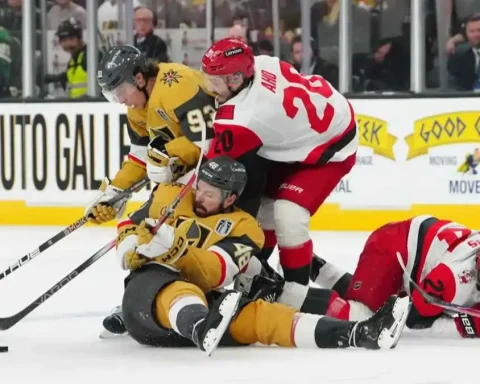
Drake reportedly lost $8.2 million as a result of a series of wagers totaling $124.5 million over a 30-day period, including a $50 million wager that lost $5 million. The NBA and NHL playoffs, which dominated the sports calendar in May and June 2025, were probably to blame, even though he did not name the specific events. Drake lost $1.25 million earlier in the year when he placed a wager on the Toronto Maple Leafs to win the NHL playoffs. The wager famously failed when the team lost to the Florida Panthers. In addition, he wagered $750,000 on RCB to defeat the Punjab Kings in a cricket match and $800,000 on the Oklahoma City Thunder to lose Game 6 of the 2025 NBA Finals to the Indiana Pacers, which could have cost him $1.7 million.
Although it is uncommon for a celebrity of his caliber, Drake’s openness about his losses fits with his image as a flawed but approachable person. “I am a flawed sports bettor,” he acknowledged in a fictitious interview promoting his Stake partnership. I don’t have that gift. Even though he is said to have a net worth of $250 million, his continued willingness to place large wagers in spite of numerous losses begs the question of the appeal of gambling and its psychological effects.
The “Drake Curse”: A Phenomenon in Pop Culture
The “Drake Curse” is a pop culture phenomenon that emerged from Drake’s gambling adventures. According to the superstition, any team or athlete he openly backs or wagers on is destined to lose. Drake-supported teams and athletes, including the Toronto Raptors, Edmonton Oilers, and even international athletes like Serena Williams and Anthony Joshua, have frequently experienced high-profile losses. Even though the curse has been statistically disproved—only 31% of the athletes he has endorsed have lost, according to some analysts—it is still a common joke among sports fans and a source of fascination.
Drake’s $1 million loss to Argentina in the 2022 FIFA World Cup final, where he wagered on a regulation-time victory but the game ended up going into extra time, was one of the incidents that gave rise to the curse. He also lost his $2 million UFC wager on Israel Adesanya vs. Alex Pereira in 2022 after Pereira’s comeback. On X, fans have even made jokes about Drake being “turned on” by the curse. One user joked, “Drake’s curse is now a boomerang.” The curse highlights a more serious problem: the gamification of sports betting in celebrity culture. The rapper has embraced the story, humorously admitting his betting errors.
The Negative Aspects of Gambling: Social and Psychological Effects
Despite being financially inconsequential to a multimillionaire, Drake’s $8 million loss brings attention to the negative aspects of gambling that impact millions of people globally. Compulsive gambling, also known as gambling addiction, is a recognized behavioral disorder marked by an inability to control one’s gambling impulses in spite of negative outcomes. About 1% of Americans fit the criteria for a gambling disorder, and millions more are at risk, according to the National Council on Problem Gambling. Celebrity endorsements and the availability of online betting sites like Stake have contributed to an increase in gambling among younger populations.
Drake believes that the psychological appeal of gambling may be found in the excitement of taking big risks, which is a characteristic shared by wealthy people and celebrities. He wrote on Instagram that he hoped to share a “big win” with his followers, implying that he would pursue the elusive “max” payout that other people appear to obtain every week. This way of thinking is similar to the gambler’s fallacy, which is the conviction that a win is on the horizon following a run of losses. Drake’s mental state has been the subject of conjecture by X critics, who have referred to him as a “gambling addict” and “reckless.” One user expressed broader societal concerns about the normalization of betting when they wrote, “Gambling gotta be one of the worst ways to spend money.”
Beyond personal psychology, Drake’s losses have provoked criticism due to the actions’ socioeconomic ramifications. His casual display of burning through $8 million has been criticized as tone deaf in light of North America’s skyrocketing inflation and living expenses. Using a line from his rival Kendrick Lamar’s diss track, one X user called him a “Certified Loser Boy.” Another said, “People are struggling to survive, and he’s throwing away millions of dollars.” Calls for responsible gambling advocacy are strengthened by these sentiments, which draw attention to the gap between the wealth of celebrities and common hardships.
Influence of Celebrities and Ethical Issues
Drake is at the center of a heated discussion regarding celebrity influence in gambling because of his alleged nine-figure partnership with Stake. He frequently distributes betting slips and hosts live-streamed events such as “Drake vs. Stake,” in which he plays roulette and distributes Bitcoin prizes, as a brand ambassador. Critics contend that despite the fact that these activities are promoted as entertainment, they glamorize gambling and give fans—many of whom lack the financial means to absorb losses—irrational expectations.
Rumors that Stake might be funding Drake’s wagers add to the ethical issues and cast doubt on transparency. If accurate, his losses could be performative rather than actual financial risk, acting as platform marketing. These kinds of agreements make it difficult to distinguish between sponsored content and real behavior, which could lead fans to believe they can live like Drake. Furthermore, Stake’s legality is in doubt in a number of nations, including the US and the UK, raising concerns about whether Drake’s posts promote unlawful gambling.
The rapper’s use of AI tools for betting advice in a recent video highlights the gamification of wealth even more. Drake runs the risk of normalizing risky financial practices among his 142 million Instagram followers—many of whom are young and impressionable—by treating gambling as a lighthearted experiment. According to proponents of responsible gambling, Drake and other celebrities ought to either make the dangers of betting more obvious or not advertise it at all.
Drake’s Reaction and Prospects
Drake is unfazed by the criticism; he doubles down with a $800,000 wager on the Thunder to win the NBA Finals and jokes that “gambling addiction is a lie made up by platforms like Stake to prevent you from winning their money.” The remark was criticized for trivializing a serious issue, even though it was probably tongue-in-cheek. In light of the gambling scandal, Drake is reportedly returning to his creative roots with a new album, tentatively titled Iceman.
Although divisive, the rapper’s candor about his losses presents a teaching opportunity. He unintentionally draws attention to the dangers of gambling, even for extremely wealthy people, by discussing “the other side of it.” His story serves as a warning to the public and fans about the allure and danger of gambling. Drake’s $8 million loss might lead to more stringent laws governing betting endorsements and increased awareness of responsible gambling as the debate over gambling addiction and celebrity influence intensifies.
In conclusion
The high-stakes, high-risk world of celebrity gambling is revealed by Drake’s admission of $8 million in sports betting losses. Even though his financial situation lessens the impact, his actions have far-reaching psychological, social, and ethical repercussions. Once a humorous meme, the “Drake Curse” now represents the larger dangers of a society that exalts gambling as a means of achieving rapid wealth. Drake’s story highlights a crucial reality as fans wait to see what he will do next, both in music and at the betting table: the house always wins in gambling, and even a famous person like Drake is susceptible to its darker side.