
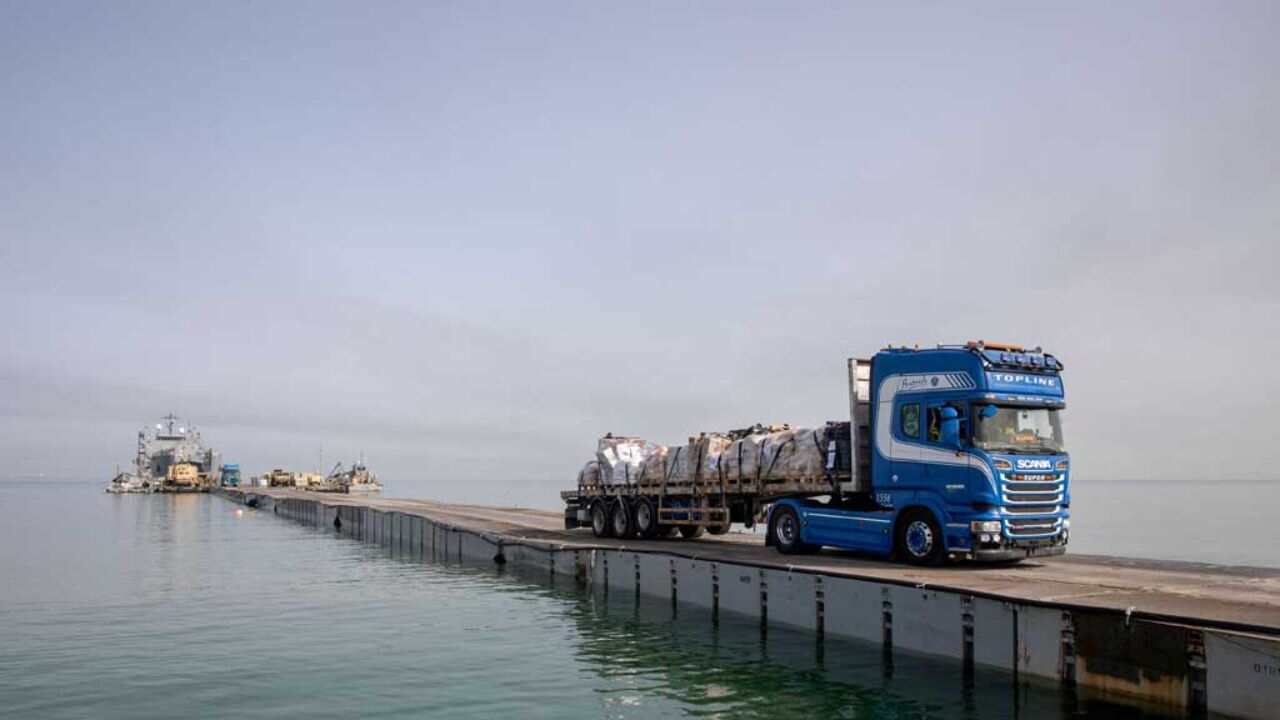
On Tuesday, the US Central Command (CENTCOM) reported that over 569 metric tons of humanitarian aid have been transported to Gaza via a temporary floating pier. However, not all of the aid has made it to warehouses. The construction of the pier aimed to facilitate the entry of more aid into the besieged and war-torn enclave. Yet, the quantity falls short of meeting the needs of Gaza’s population, which exceeds 2 million, with over half of them displaced.
The pier, pre-assembled at the Israeli port of Ashdod, began operations on Friday as Israel came under growing global pressure to allow more supplies into the besieged coastal enclave. The US-led military alliance of NATO and Arab states, as well as the United Nations, has pressed Israel to ease restrictions on supplies into Gaza in an attempt to mitigate the impact of seven months of Israeli air strikes, a siege, and a ground offensive against Hamas militants.
Aid deliveries began arriving at the pier on Friday, and the UN confirmed that ten truckloads of food aid, transported from the pier by UN contractors, had reached a World Food Programme warehouse in Deir El Balah on Saturday. However, 11 other trucks were reportedly cleaned out en route through an area that a UN official, speaking on condition of anonymity, described as difficult to access. No more truckloads arrived on Sunday or Monday.
A UN official told RTE on Tuesday that the areas of southern Gaza that were crowded with displaced people a few days ago now have “quite an eerie quiet, but there is regular bombardment and the constant buzzing of drones.” Sam Rose, Director of Planning with the United Nations Relief and Works Agency for Palestine Refugees, added: “People are leaving because they can’t take it anymore. There’s no water, no sanitation, and a real sense of despair.”
An Israeli airstrike on Tuesday hit the Jabalia camp in northern Gaza, laying waste to residential districts with tank and rocket fire as Israel pursued its offensive against Hamas in response to a deadly Oct. 7 attack that killed more than 2,000 in the enclave. The assault has caused a massive Palestinian exodus, driven by hunger, and sparked calls for a ceasefire to allow lifesaving supplies.
The Security Council voted on Monday to approve a resolution that reaffirmed the right of all people in Gaza to live in peace without imposing conditions on that right. But the weakening of language on a cessation of hostilities to allow in aid frustrated many council members, including veto power Russia and Arab and Organisation of Islamic Cooperation countries that see it as approval for Israel’s actions. Washington has defended its strategy, saying it is necessary to target Hamas tunnels, destroy militant rocket firing, and rescue hostages. The UN says a humanitarian catastrophe is unfolding, and only about 10% of the food needed has entered Gaza since the war started. The enclave is also experiencing a power crisis and a fuel shortage as Israel imposes a tight blockade on the territory.