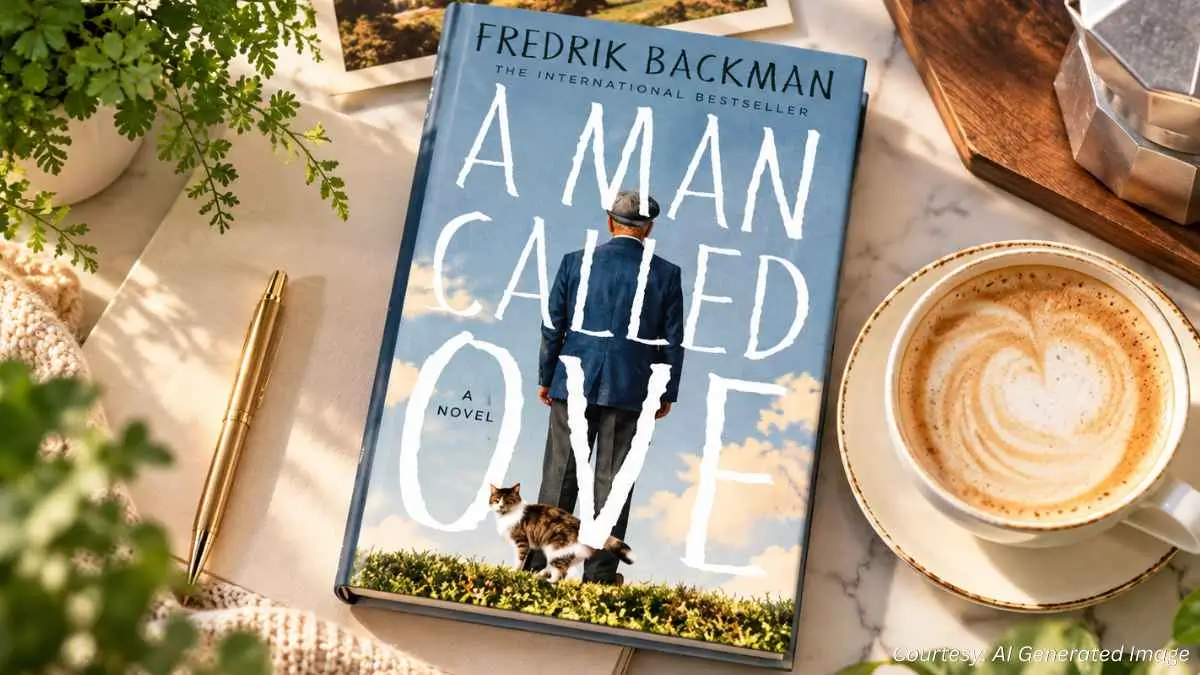
A Man Called Ove is a debut novel written by the Swedish author Fredrik Backman. Its original Swedish title is En man som heter Ove. The novel was published for the first time in Sweden by Forum on 27 August 2012. In English, the novel was published in 2014 by Henning Koch under the title A Man Called Ove at Atria Books on 15 July 2014.
The story centers on Ove, a 59-year-old widower living in a small Swedish housing association. Strict, principled, and notoriously grumpy, he drives only Saabs, enforces neighborhood rules with obsessive diligence, and has little patience for modern technology, bureaucracy, or people who do not do things “properly.” Six months after the death of his beloved wife Sonja and shortly after being forced into retirement, Ove decides he has nothing left to live for and repeatedly attempts suicide so he can be reunited with her.
Each attempt is comically and persistently interrupted—most often by his new neighbors, especially the loud, pregnant Iranian woman Parvaneh, her accident-prone husband Patrick, and their two young daughters. Through a series of reluctant acts of help (driving lessons, fixing things, sheltering a stray cat, and standing up to bureaucratic “men in white shirts”), Ove is gradually drawn back into the lives of those around him.
There are shifts from present to flashback scenes to tell Ove’s story. Brought up by a hardworking and soft-spoken railway-worker father following the death of his mother at an early age, Ove learns that a man’s value is defined not by what he says but by what he builds and repairs. He encounters the dynamic and caring Sonja on a train ride, who turns out to be the focal point of his life. Their marriage is interrupted by the bus accident that leaves Sonja paralyzed and takes away their baby.
Ove manages to adapt their life to meet her requirements and struggles against the system for her to keep teaching. Following her death due to cancer, his inflexible routines are not only a form of coping but also an obstruction. The book illustrates that beneath Ove’s tough exterior lies loyalty and deep ability to love.
Backman explained that he got the idea for the character from an article in a newspaper about a man called Ove who got enraged during the process of purchasing tickets at an art museum. With regard to the social awkwardness of the man, Backman started posting blogs under the title “I am a Man Called Ove” and later turned it into the novel. The chapters in the book are intentionally kept short, comparable to those of a magazine article.
A Man Called Ove was an international bestseller. It hit the New York Times Bestseller list about 18 months after its English-language publication and stayed there for 42 weeks. By the mid-2010s, it had sold millions of copies all over the world (over 2.8 million by 2016, and higher estimates were reported later on) in dozens of languages. In Sweden alone, it had sold hundreds of thousands of copies. Praises were given to its wit, emotional depth and humanization of an unsympathetic main character.
According to Kirkus Reviews, it had a perfect ratio of fable-style back-story and hysterically funny scenes from the contemporary life, and Publishers Weekly called it a “fuzzy crowd-pleaser” that combines laughter and thoughtful examination of grief and love. It may be noticed that some parts of the book are a bit repetitive and sometimes a little bit sentimental, but the witty prose and contrast between Ove’s attitude and deeds make everything right.
The book has inspired many adaptations. In January 2015, there was a play version of the book performed on stage in Sweden with Johan Rheborg playing the main character. There has also been a successful film adaptation of the book in Sweden in 2015 directed by Hannes Holm with Rolf Lassgård as the main character; the film was nominated for several Guldbagge Awards and Academy Awards, including best foreign language film and makeup & hairstyling. The 2022 remake in America titled “A Man Called Otto” starred and was produced by Tom Hanks.
On the most basic level, the novel shows how adherence to rules and routine serves to insulate one after devastating tragedy while at the same time opening oneself up to the unpredictability of human connection and the way in which human connection can give one meaning. Ove never quite loses his gruffness or principle in the novel, but through the course of the book, he ends up creating a chosen family in the form of his neighbors. When Ove finally dies from an undisclosed heart ailment years later, thousands of people attend his funeral, showing how even the smallest of lives can touch many others.
About the Author
Frederick Backman (full name Carl Fredrik Backman, born on June 2, 1981, in Brännkyrka, Söderort, located near Stockholm, Sweden) is a Swedish novelist, blogger, and columnist. He is best known as the author of the debut novel “A Man Called Ove.” He spent his childhood in the town of Helsingborg, in the region of Scania. Prior to becoming a professional writer, Backman enrolled in university to study comparative religion; however, he eventually left university studies behind.
Backman got his start as a writer by being a columnist and blogger, working for newspapers like Helsingborgs Dagblad as well as men’s magazines such as Moore Magazine. In 2009 Backman began to write on his own blog, in which he focused on small annoyances, social discomforts, and personal insights.
Writing about a grumpy and idealistic person known as Ove, partly based on a news article about a man who had gotten angry at an art gallery, Backman created his first novel. En man som heter Ove was published in Sweden in 2012 by Forum (A Man Called Ove in English, 2013/2014). It has gone on to become a best-selling book around the world, hitting the New York Times list and staying on it for several months.
His other books have followed suit by being commercial and critical successes both in Sweden and worldwide. Some of them include Things My Son Needs to Know About the World (2012), which is a book of nonfiction and draws from his experience as a father of a child; the novels My Grandmother Asked Me to Tell You She’s Sorry (2013) and Britt-Marie Was Here (2014); the Beartown trilogy (Beartown/Björnstad (2016), Us Against You (2017), The Winners (2021/2022)), which explore the themes of community, loyalty, and violence in the story of an ice-hockey club in a small town; Anxious People (2019/2020); and My Friends (2025).
Most of these books have occupied the top position on Swedish bestseller lists and other international charts. They have also been adapted into films and TV series like A Man Called Ove/Otto, a movie version and a TV series based on Beartown; Anxious People; and Britt-Marie Was Here.
In 2009, Backman got married to Neda Shafti Backman and has since had two children. In speaking about his style of writing, he refers to humor, a touch of melancholy, and the ability to comment on how regular people deal with loss and their communities amid everyday absurdities. Even though the manuscript was initially turned down commercially, its unforeseen international success made Backman one of Sweden’s best-selling literary authors.