
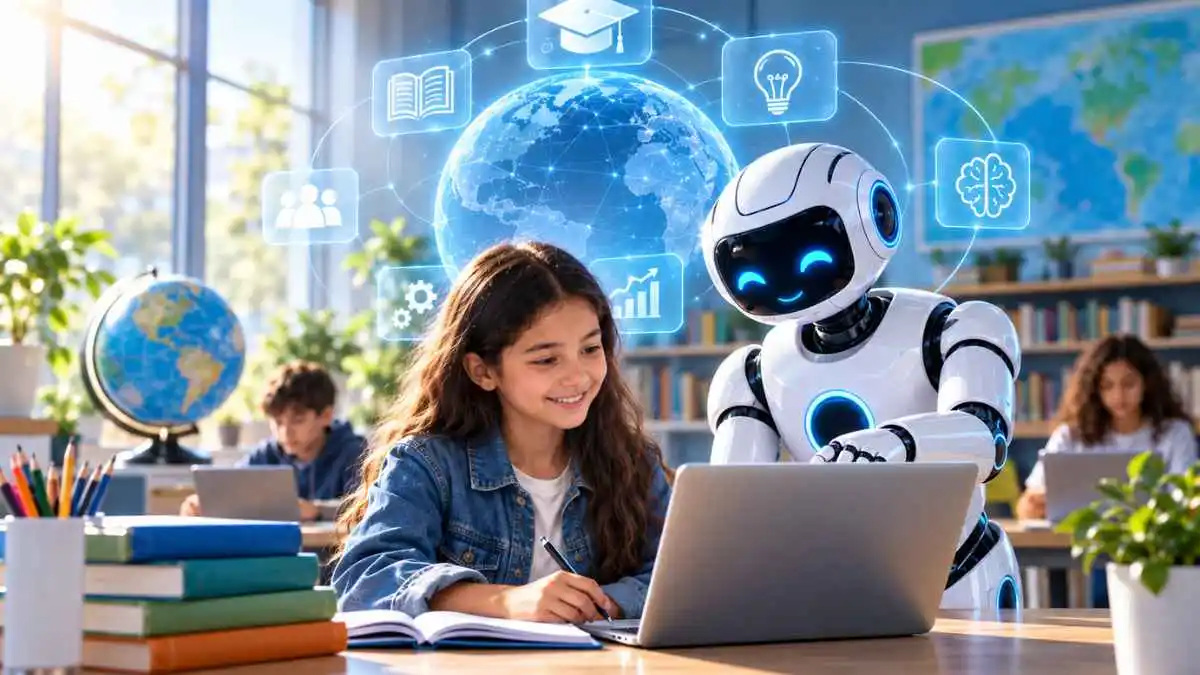
Education has always been shaped by the tools at its disposal. The printing press brought knowledge to the masses. The internet changed the face of the classroom. In contrast now, artificial intelligence is doing something that these revolutions only partially achieved: making learning deeply interactive and personal, yet still scalable. Artificial Intelligence is more than just a new educational technology; it’s a new fundamental way of delivering knowledge, tracking success, and understanding how every student, no matter what their background or capabilities are, can be reached and supported.
Individualized Learning at Unprecedented Scale
Content has never been the most durable barrier in education. The real problem has always been the impossibility of one teacher simultaneously teaching thirty different learners, each with different strengths, gaps, paces and interests. The average student is a myth on which all traditional classroom instruction is based and is rarely found in real life, however well the instructor may perform. AI is tearing down this wall, allowing for truly adaptive learning experiences that respond to individual performance in real time.
AI-powered learning platforms analyze how a student interacts with material — where they slow down, which concepts spark confusion, which kinds of problems they solve quickly and which they avoid — and constantly modify the difficulty, format and order of content in response. A student strong in mathematical reasoning but weak in geometric reasoning receives more targeted help in the area of need while continuing to make confident progress in areas of strength. This kind of dynamic personalization, once only available to students wealthy enough to afford private tutors, is now being delivered at scale to classrooms around the world.
Intelligent Tutoring and On-Demand Assistance
One of the most important contributions AI is making to education is the rise of intelligent tutoring systems – AI-powered tools that can interact with students in a conversational manner to help them learn outside of school hours. A student wrestling with a tough physics problem at nine at nite no longer has to wait until the next morning for clarification. AI tutors can help them through the reasoning process, suggest different explanations, ask probing questions to find out where they are going wrong, and offer immediate, accurate feedback – all without the social anxiety some students feel when they have to show their confusion in front of peers or authority figures.
This always-available aspect of AI support is especially important for students in underserved communities, where access to qualified teachers, textbooks and after-school programs is uneven. AI won’t be able to fix the systemic inequities baked into education, but it can vastly expand access to quality instruction for students historically underserved by it.
Changing the Role of the Teacher
A common worry about AI in education is that it threatens the role of the teacher. But a more complex picture is that AI is changing what teachers spend their time doing — and in the process has the potential to make teaching a more sustainable and intellectually rewarding profession. By handling the mundane tasks of grading routine assessments, monitoring each student’s progress and creating differentiated practice materials, AI gives teachers the time and space to focus on the parts of education that machines can’t replicate: mentoring, facilitating discussion, ethical reasoning, emotional support and nurturing curiosity.
Powered by AI, data dashboards provide teachers a clearer, more granular picture of what is happening in the classroom than any traditional assessment tool can. A teacher who can see at a glance that twelve students are struggling with the same concept and eight other students are ready to move forward can make far more strategic instructional decisions than one who is relying on test scores and intuition alone. Here, AI serves as a powerful amplifier of teacher capability, not as a replacement for it.
Early Detection of Learning Difficulties
Besides various ways AI is gradually transforming education and learning, a very underappreciated example of AI application would be the utilization of AI to catch learning difficulties earlier than expected, and some times even before a student is aware or parents and teachers have noticed a certain problem. Dyslexia, dyscalculia, and attention-related disorders are some of the most frequently misinterpreted or even completely ignored for a long time conditions.
This is even more probable in a case when a teacher with a big number of students misinterprets or misses an abnormal behavior completely. AIs, which monitor learning patterns and track students performance (materials used, time consumed, mistakes made, and methods of comprehension) help educators find deviations that might be a sign of some learning disabilities. These deviations may be indicators for intervention and support at the earliest stage.
Detection at an early stage is very crucial. Extensive research shows that if a student has a learning problem and that student is identified and helped in time, then the problem is unlikely to lead to long term school avoidance, reduced self confidence and ultimately, life disappointment. AI-based early warning systems are a great step that schools can take to ensure, among other things, that nobody is left behind by the system because of their needs being overlooked.
Equipping Students for an AI-Infused World
Beyond the classroom, AI is influencing how students will engage in life generally. What AI is capable of equipping the students with is, after all, an important part to think about in any case. The fact is that artificial intelligence is transforming the jobs and the economies of the world that the students who enter today will soon be part of. That sort kind of change is definitely happening and accelerating.
A top notch AI education system is one that not only uses technological methods as a means of communication to students but also helps them to gain insights and work with those technologies. Skills such as working with AI tools, data reasoning and online literacy now serve the role of being basic skills just like reading and arithmetic did.
Schools which not only inform about but help students become actively involved with AI through meaningful and organized learning – as the thinking persons that they are – the students not only know how these platforms work but even question and interrogate the workings (how they work), assumptions behind the platforms (what the platforms encode), and the weaknesses (where their limitations lie) of those systems – are because of this giving these students a considerable edge. The objective is really a generation that can lead in an age of AI (a generation that is not only AI-savvy but is also capable of steering a future where AI plays a big role), not a generation of people who are dependent on AI.
Building a Fair and Responsive Future
AI’s promise for education is not a sure thing. Careful implementation, strong data privacy safeguards, culturally sensitive design, and ongoing assessment are necessary to guaranty that the tools being rolled out actually benefit all learners — not just those whose data and learning styles are most visible in the systems that trained the algorithms. There is a genuine risk that badly designed AI tools will reinforce existing inequalities and this must be taken seriously by developers, policy makers and educators alike.
But AI in education, when done with integrity and intent, is one of the most powerful levers we have to build a more equitable, adaptive, and effective learning system. The classroom of the future won’t resemble the one most grown-ups recall—and for millions of students who never thrived in the old paradigm, that is a good thing.